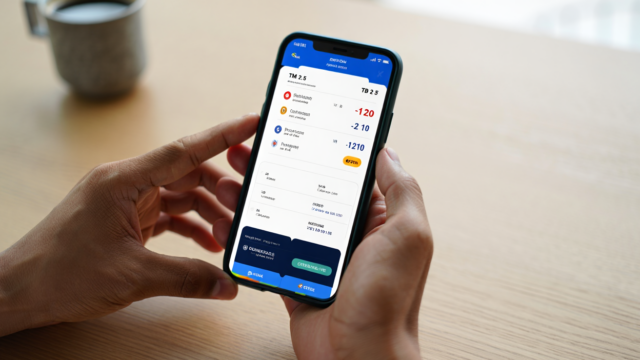

Half-time betting works by having you predict both the half-time result and the final match outcome in a single wager. This combination creates nine possible outcomes, known as “Time/match” bets: P1/P1 (home team leads at half-time and wins), X/P2 (draw at half-time but away team wins), or P1/P2 (home team ahead at half-time but away team wins the match).
The appeal lies in the odds. A typical home win pays 1.8 to 2.0. The same home win combined with a half-time draw can reach 5.0 or higher. Expect even steeper odds for comebacks: a team trailing at half-time but winning the match might offer 15.0 to 50.0 depending on the bookmaker and league.
Some bookmakers enhance these markets by combining outcomes. Instead of picking a single result, you might bet “home team wins in both halves” or “away team doesn’t lead at half-time but wins overall.” Others bundle total goals into the equation, requiring both a specific half-time score line and the full-match goal count to fall within a range.
What Are the Best Football Bets?
The strongest selections depend entirely on your preparation. Before wagering on any match, you need three types of information: tactical setup, team motivation, and recent statistics.
Tactical analysis begins with formation and style. A team playing 5-3-2 with defensive emphasis typically concedes fewer first-half goals than a 4-2-4 side. Check whether the squad started the season quickly or slowly. Some clubs historically dominate the opening 45 minutes because their manager prioritizes an aggressive press; others deliberately sit deep, absorb pressure, and strike on the break. This pattern often repeats across multiple matches, making half-time predictions more reliable than exact scorelines.
Motivation shifts the entire picture. A team needing victory plays differently than one already qualified or mathematically eliminated. In group stages, the second or third match frequently shows extreme variance because one side fights for progression while the other rests key players. Austria might arrive organized but without intensity if already eliminated, while Argentina pushes hard with Messi in form and motivation high. The odds reflect squad quality, but motivation compounds or deflates expected performance.
Statistical foundations matter more than gut feeling. Review the past five matches for both teams. Calculate how often each side went ahead in the first half. Note the average goals conceded before half-time versus after. If Team A conceded twice in the first 45 minutes in three of five matches but zero times after half-time in four matches, that’s a concrete pattern worth betting on.
Strategies for Half-Time and Full-Time Predictions
Consistent strategies emerge from studying team habits rather than match difficulty. Some squads are notoriously slow starters. They trail 0-1 at half-time in 60% of games but win 45% overall because their second-half intensity shifts everything. Betting on P2/P1 (away team leads at half-time, home team wins) repeatedly against such teams builds an edge over time.
The reverse applies to aggressive teams. If a side wins the first half in 70% of matches and finishes 1-0 up in 55%, then P1/P1 becomes more predictable than general match betting. You’re not guessing; you’re recognizing behavior.
Focus on leagues where statistics are deep and reliable. Top five European leagues offer better data trails than lower divisions or smaller nations. A club in Serie A has 20+ matches annually against known opponents. A team in a 16-match second division season has far less comparative information.
Avoid corner cases where one team rests entirely. A strong side’s youth squad versus the league’s second-best team creates unpredictable chaos. The favorite’s odds collapse, but so does reliability. Wait for matches where both squads field competitive lineups with realistic motivation.
Accurate Predictions Framework
Accuracy improves when you accept that no reliable universal strategy exists. Instead, build a personal checklist. Before placing money on any bet, verify these elements:
First, confirm the starting XI. Injury to a key defender changes first-half vulnerability. Messi playing versus Messi rested shifts Argentina’s attacking output dramatically. Check official team sheets 30-60 minutes before kick-off, not three hours earlier.
Second, identify the tactical mismatch. Does one team’s press overwhelm the other’s passing under pressure? Does a deep defensive line play into long-ball strength? These gaps often widen in specific halves. An organized but slow-starting defence cracks more in the first 20 minutes than the last.
Third, examine recent performance in identical situations. If Argentina won their last two opening group matches 1-0 with both goals after minute 35, then betting on a tight first half followed by a second-half goal makes more sense than predicting chaos.
Fourth, recognize external conditions. Extreme heat, altitude, or travel fatigue affects second-half output more than first-half sharpness. Cold climates help defensive teams maintain intensity throughout.
Europe’s major leagues show that goals cluster around minute 15-25 and minute 65-75. Early attacking waves happen when defences aren’t organized. Late goals emerge from fatigue and desperation. Half-time predictions should account for this rhythm.
Common Pitfalls
Overestimating squad quality without considering match situation loses money fast. France showing class against Senegal tells you about France’s ability, not whether France will dominate Iraq’s first half when Iraq might already play without pressure. Similarly, betting without recent form data ignores the human element. A team that lost 1-4 but stayed competitive might perform differently in the next match depending on morale and coaching adjustments.
Ignoring odds distribution prevents you from spotting value. If P1/P1 offers 2.2 but P1/X offers 3.8, and statistics show the home team leads at half-time 65% of the time with 55% draws in those situations, then the second option carries hidden value. Bookmakers price common outcomes lower and rare ones higher, but frequency and likelihood don’t always align.
Never chase odds. A 50.0 comeback bet excites, but it reflects genuine improbability. Unless you have data showing teams overcome half-time deficits 3% of the time (making 50.0 slightly underpriced), that bet is speculation. Small, consistent gains outpace rare large wins from wild wagers.
Building Your Approach
Start with matches involving teams you follow closely. Personal knowledge of a club’s season arc, recent form, and tactical preferences gives you an information advantage. Gradually expand to other matches only after you prove consistency in your core selection.
Track every bet in a spreadsheet. Record the prediction, the odds, the result, and why you chose it. After 50 bets, review which predictions hit and which missed. If your P1/P1 bets win 40% of the time at 2.5 average odds, you’re breaking even or slightly losing. If P2/X bets win 35% at 3.2 average odds, you’re likely profitable because you only need 31% wins to break even at those odds.
Treat each match as a testing ground for your framework, not a gambling event. The best bets emerge from discipline, not inspiration.