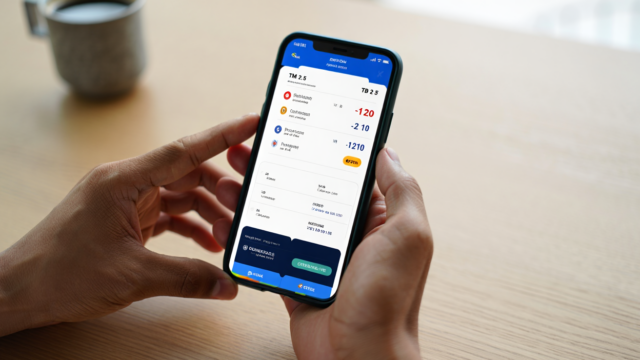

Standard football betting lines at major sportsbooks include match outcomes (1X2 format), total goals, handicaps, and half-time/full-time combinations. Lines tighten significantly as match day approaches. A match listed at -110 (American odds) for a top-seeded nation may shift to -130 once qualifiers confirm their squad and starting lineups. This movement creates opportunities for early value hunters who identify mispriced outcomes before the general betting public catches up.
Express Bets and Accumulator Strategy
Express bets, commonly called accumulators or parlays, combine multiple selections into a single wager where winnings roll forward through each event. A three-event express with odds of 1.51, 1.66, and 3.88 produces a total multiplier of 9.72. If all three selections win, a 5% stake generates a return that equals 5% multiplied by 9.72, turning smaller initial bets into substantial payouts.
Professional services like STAVKA TV publish daily express combinations across football, hockey, and other sports, justifying each selection with tactical analysis and team form metrics. Their “Express of the Day” covers elite leagues including the English Premier League and KHL, with daily updates allowing bettors to compare odds across different bookmakers before locking in selections.
The mathematical appeal of accumulators lies in odds multiplication. Three selections with individual odds of 1.29, 1.41, and 1.48 produce a combined multiplier of 2.7, generating 170% profit on a successful bet. However, this structure carries inherent risk: a single losing selection eliminates the entire wager, regardless of how many picks won. xGscore reports a seven-win streak in their Telegram channel using carefully selected 3-4 event combinations, though such consistency remains exceptional rather than standard.
Building Profitable Express Combinations
Constructing a winning express requires mixing odds tiers strategically. The foundation typically includes one heavy favorite (odds around 1.3-1.4) to stabilize the bet, one mid-tier selection (1.5-2.0), and one value play (2.0-4.0) that offers asymmetric reward. This structure balances win probability with multiplier potential.
Form analysis drives selection quality. Teams demonstrating strong recovery patterns, stable lineups, and favorable matchups yield better outcomes than fixtures between evenly matched opponents. Basilashvili’s early exits from grass tournaments, contrasted with players like Tomic who maintain experience across surface transitions, illustrate how surface-specific performance history influences selection accuracy. Similarly, Torpedo Kutaisi’s historical home-ground advantage at 4.60 odds reflects genuine tactical patterns rather than random chance.
Stake sizing at 5% per express prevents catastrophic losses during downswings. Professional forecasters using this approach manage variance effectively across multiple daily selections. Betzona’s historical records show two-event and four-event combinations coexisting within the same day’s recommendations, allowing bettors to adjust risk exposure based on confidence levels and available edge.
Comparing Professional Predictions and Expert Analysis
Platforms like vseprosport.ru maintain expert networks covering European top leagues and secondary leagues during summer windows. Their analysts publish 20-25 daily predictions on weekends, concentrating on 1X2 outcomes, totals, handicaps, corners, and card predictions. This volume allows bettors to identify expert consensus and divergent opinions simultaneously.
Expert performance statistics, tracked per league and analyst, reveal which specialists maintain edge in specific tournaments. An expert demonstrating 55% accuracy in qualifying matches merits different weighting than a generalist covering all leagues. These platforms enable filtering by expertise domain, preventing false averaging of predictions across unrelated competitions.
Express football betting forecasts published on such platforms combine multiple experts’ selections, presenting both reasoning and historical success rates. A recent forecast combining Basilashvili-Ymer exact score (2:1), Uchida-Tomic exact score (0:2), and Rocha-Mejia first-set/match combination yielded 9.72 total odds with explicit reasoning tied to tournament history and player strengths. This transparency allows bettors to evaluate whether selection criteria match their own analytical framework.
Managing Bookmaker Margins and Hedging Tactics
Standard sportsbooks embed 3-5% margins into football lines, meaning implied probabilities exceed 100%. This inherent house advantage compounds across multiple selections in express bets. A bettor selecting events with true 55% win probability faces significantly longer odds drift when combining four selections, as the bookmaker advantage multiplies geometrically.
Hedging protects express profits or limits losses as matches unfold. Once three of four selections win decisively, selling the remaining selection back to the bookmaker crystallizes most of the accumulated value while removing remaining downside. xGscore notes this “double insurance” strategy allows bettors to exit winning positions without forcing the final selection to land. Conversely, hedging with opposite bets on the final selection creates a guaranteed return band rather than all-or-nothing outcomes.
Bookmaker bonuses and promotions alter effective margins significantly. A 20% deposit bonus converts a typical 4% house edge into a 2.4% edge when calculated across the full bonus-inclusive bankroll. Professional bettors time accumulator selections to align with promotional windows, leveraging bonus credits toward positions offering true value.
Data-Driven Selection vs. Public Betting Trends
Historical betting patterns reveal systematic public biases. Retail bettors overweight favorite teams, creating line movement favoring underdogs in fixtures between elite nations. Excessive moneyline action on favorites pushes 1X2 odds to compressed levels, while underdog prices compress below true probability.
This public tendency creates opportunities for contrarian positioning. A team historically strong in first-half territory generates inflated 1H odds, yet historical data shows consistent win rates supporting better odds. Early-market positioning captures these inefficiencies before consensus develops.
Matches showing specific patterns-exact scores, first-set combinations, or goal-differential requirements-contain elevated odds reflecting their lower historical frequency. The Rocha-Mejia combination at 1.51 priced player strength factors specific to tournament conditions, not raw outcome probability.